


Elena Verna penned a piece about throwing out her playbook six months into her new role. I found myself nodding the entire way through. Her post focused on how quickly LLMs are evolving and how that pace forces you to constantly relearn how to work.
For me, that same learning curve has come from joining a startup for the first time. After years in corporate environments like Spotify, Audible, and SoundCloud, this experience has been a complete rewiring of how I think, operate, and lead.
I came in with a deep trough of experience, well-tested systems, frameworks, and processes that had served me well for years. Yet, I quickly realized how much of it didn’t directly translate.
What’s become clear is that my most valuable skill isn’t domain expertise. It’s adaptability: the ability to reorient mid-air, build structure in ambiguity and stay grounded while everything shifts around me.
Inspired by Elena’s post (yes, I even copied her title), here’s a peek at how I’ve had to adapt my usual playbooks: breaking my own systems to move inside a fast-paced business where the people are the product.
But first….
(running my own ads on my own Substack: cheap, easy, no approvals necessary)
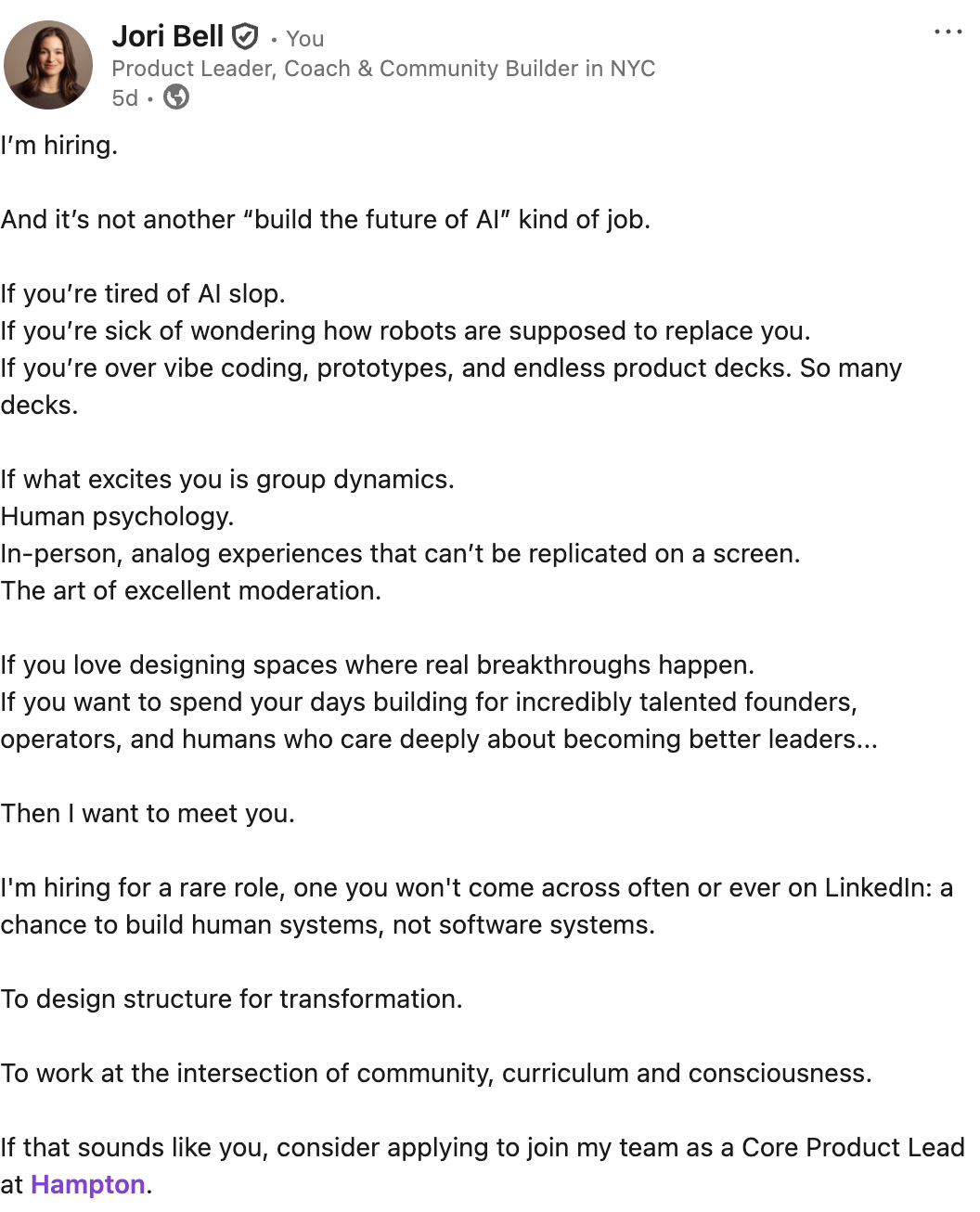
I’m hiring!
I’m hiring for an incredibly unique role on my team at Hampton. I’m a product person who’s focused on delivering exceptional IRL experiences to founders. And I need help. Read more about it and apply here (or pass along!) if this sounds interesting!
Now…back to regular programming…about adapting playbook…
1. Scope of Role Fluctuates
My onboarding plan was outdated before I even started. I joke about that now, but it’s true. Since joining, I’ve taken on new teams, offloaded responsibilities, and watched my role evolve almost weekly. The shape of my job has never been static. While that’s felt destabilizing, it’s certainly interesting - and often energizing. Why? It means the business is alive, and I’m learning to flow with it instead of resisting it.
Resistance causes pain. So flow or bust.
In big tech, I had entire teams dedicated to research, analytics, design, and comms. Now, I’m part operator, part strategist, part communicator - often all at once.
The constant recalibration has forced me to redefine stability. Instead of measuring it by consistency, I now measure it by responsiveness: how quickly I can pivot while still keeping my bearings.
Related reading as I was learning to cope with this:

2. Doing Less With More
One of the biggest adjustments has been letting go of the idea that quality work requires big teams and abundant resources.
In corporate environments, I had access to every specialist imaginable. At a startup, you learn to be scrappy. You experiment more, polish less, and accept that “good enough” often beats “perfect.”
As a recovering perfectionist, its been a hard pill to swallow. Yet…
Working for myself before this role helped me develop that muscle.
It taught me to build without bureaucracy, to iterate without waiting for permission, and to trust momentum over meticulousness. (cut to me in January 2024 wasting months tinkering with a coaching website…)
Constraint can be clarifying: it forces you to decide what truly matters and to pour energy into the few things that will make the biggest difference. Focus is everything…

3. Speed vs. Integrity
Startup speed is real. Especially when you’re working for founders.
In my previous life, I built roadmaps that spanned three, six, or nine months and could defend them with precision.
Now, a single week can feel like a month.
Plans are hard to maintain and even harder to defend. Context switching is high, sprints are shorter, decision loops need to be quicker.
At first, that pace felt chaotic.
But I’ve learned that the roadmap still matters, just in a different way. It’s less about prediction and more about alignment: a north star that helps me decide what not to do.
Ruthless prioritization has become my most important discipline. The tension between speed and quality never goes away. The challenge isn’t choosing one over the other; it’s learning how to honor both just enough to keep things moving with integrity. Again, recovering perfectionist..
4. Data-Informed vs. Data-Driven
Another shift has been in how I make decisions. In corporate environments, I was trained to be data-driven: to validate every choice with comprehensive research, testing, and statistical confidence. The kind of planning that took months.
In startup life, that luxury doesn’t exist. You don’t have perfect data or endless time to gather it. You have patterns, proxies, and instincts.
Being data-informed means trusting those smaller signals: listening to six customer conversations and spotting the trend, making directional calls with incomplete information, and learning to trust your judgment. It’s less about proving certainty and more about moving with confidence. This shift has stretched me in ways I didn’t expect, forcing me to balance intuition with evidence in a more fluid, human way.
Honestly, it’s been quite freeing.
5. Holding the Plan but Keeping It Adaptable
The thing that keeps me grounded in all of this is having a plan, but not clinging to it. I’ve learned that structure provides stability, but rigidity creates friction. My mindset has shifted from “How does this break my plan?” to “How do I incorporate this into my plan?” The plan is no longer a fixed document; it’s a living system that evolves with the work.
And on some days, its evolving hour by hour.
When new or shifting priorities arise, I try not to see them as disruptions but as opportunities to integrate and strengthen the larger whole. Every time I think I’ve built the perfect system, the work asks me to break it again.
It’s completely different than how I’ve always worked.
It’s uncomfortable.
Which means I know I’m growing.
It’s easy to romanticize speed and flexibility, but what I’ve learned is that true adaptability about holding onto your principles while rethinking your methods.
These six months have reminded me that every playbook eventually expires. What endures is how you learn to rebuild it for the season you’re in.
Have you ever had to transform your playbook? Gone from Corporate to Startup or vice versa? I’d love to hear what you did that ushered you through the transition!
I’m Jori Bell, VP of Core at Hampton. I’m also a Product Coach for Product Leaders. I have one more open coaching spot this season—if that sounds like something you’ve been craving, reach out.
"trust momentum over meticulousness" <-- loved this
Excited to see who works with you! They are lucky!!!