


Two years ago when I started to explore product coaching, Marty Cagan published what’s become one of his most popular posts: Becoming a Product Coach. It was one of the most important things I read because it gave me the confidence to get started.
Now, two years into my coaching journey (Year 1 reflections), I’m readying to launch another career pivot, one that I couldn’t have seen coming two years ago let alone two months ago.
While I’m not ready to share details yet, I am ready to share some of my biggest reflections over the past two years: on being a product coach, building a business and taking a bet on myself. Marty’s article was a crucial resource for me in a time of uncertainty. So, in honor of my two year anniversary, I’m sharing my biggest lessons in hopes of being a resource for someone else. I’ll cover three different areas because my audience isn’t just product managers:
Tips for folks getting into coaching
Tips for hiring a coach
Tips for people looking to leave a traditional career path
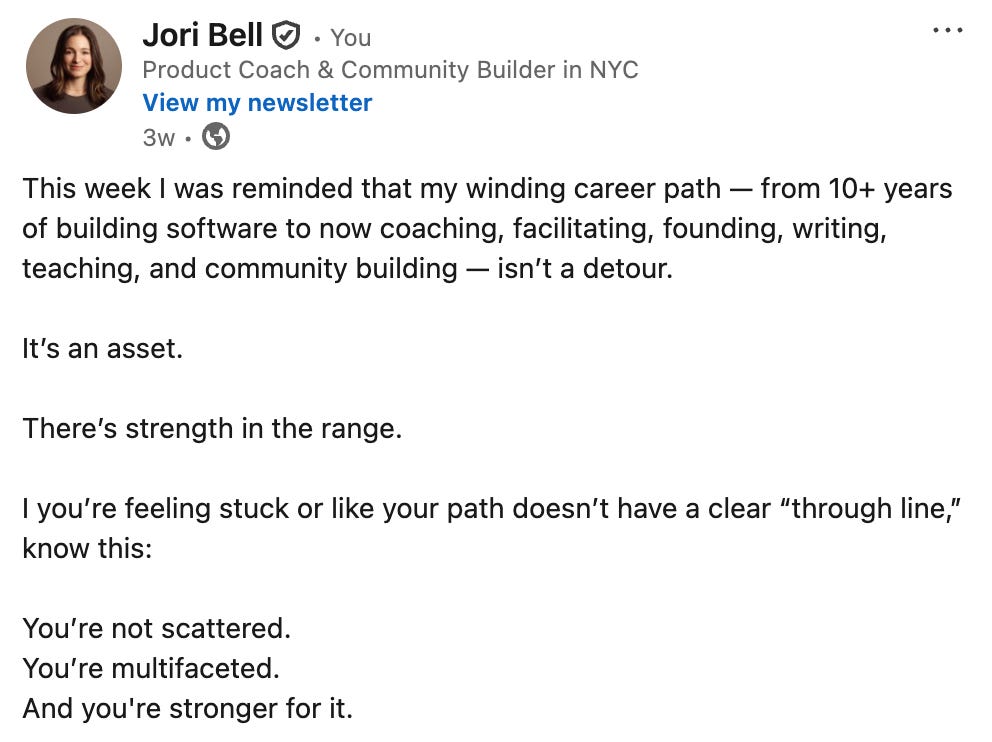
Without further ado, here are my biggest takeaways from my winding journey:
If you’re considering becoming a product coach, or any type of coach for that matter
Get data through reps
Between teaching, interview coaching, group, team and 1:1 coaching, I coached over 300+ humans over the past two years. Reps gave me confidence, but more importantly, data. Prioritize reps so you can learn: what you like (product market maker fit is important!), where you serve people best and what your differentiating factors are. The coaching market is crowded. What do you uniquely bring to the table?
Invest in the business, early
Invest in the business early, even when you may not have the income to do so. Spend time and resources on the areas you need most help with. For me, that was hiring a sales coach. Not only did hiring a coach catalyze my process, accountability and sales tactics. It helped me build empathy for my clients. If I couldn’t cough up the money to invest in myself, how could I expect others to do the same? If it feels like a big leap, start with reading The Prosperous Coach.
Invest in yourself, outside of the business, always
Working for yourself is liberating. But it can be oh so hard to unplug. Some of the most important investments I made during this time were well outside of my business. It was only in the past two years where I was able to nourish and pickup new hobbies (dance, pickleball, improv, mixing music) and do those “big things” I’d always say I’d do (solo travel, The Hoffman Process). I found that the time I spent fully unplugged from my business were the most fruitful because I was able to recharge and come back to work stronger, mentally.
Find Your People
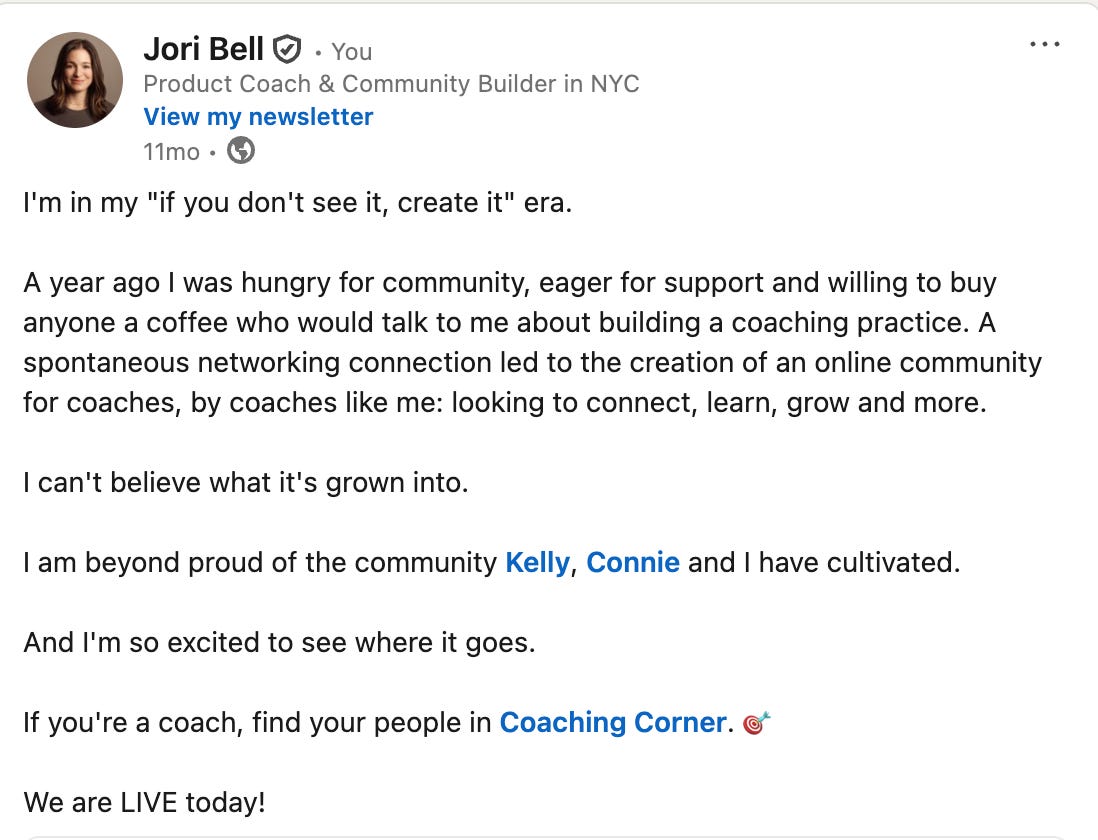
One of the reasons I was able to sustain on this path for as long as I did was because I found and created community. The Old Girl’s Club was pivotal in helping me envision a solo business and the team at Cornell Tech reminded me what it felt like to be a part of a healthy, supportive team. Joining a community space reminded me that I had a place to belong and building communities of my own, like Product Leader Breakfast and Coaching Corner gave me the creative space to design and show people why community matters.
Follow people that inspire you. For me that was people like Elena Verna, Ravi Mehta, Lenny Rachitsky, Michael Lin, Elizabeth Gilbert, Wes Kao and Gabrielle Bufrem.


The decision to get ICF certified
Many coaches decide to go through coaching certification programs before they become a coach. But because it’s an unregulated industry, there are no certification requirements to start coaching. In hundreds of discovery calls, I’ve been asked once if I was a certified coach. My experience working in large tech orgs as a Product Leader was much more important to my clients. If I had the time for certification work, I would have likely signed up to train with Co-Active or New Ventures West. Within my coaching community, it’s about 50/50, half certified and half not. But, it’s unlikely that being an uncertified coach impeded my ability to coach people or demand a fair fee.
Hold the vision, but be prepared to pivot
Part of why I chose the coaching path is because I identified it was something I really loved to do. I didn’t get into coaching to become rich or to be a LinkedIn influencer, I did it because I loved how I felt while I was coaching, teaching, facilitating, curating and community building.
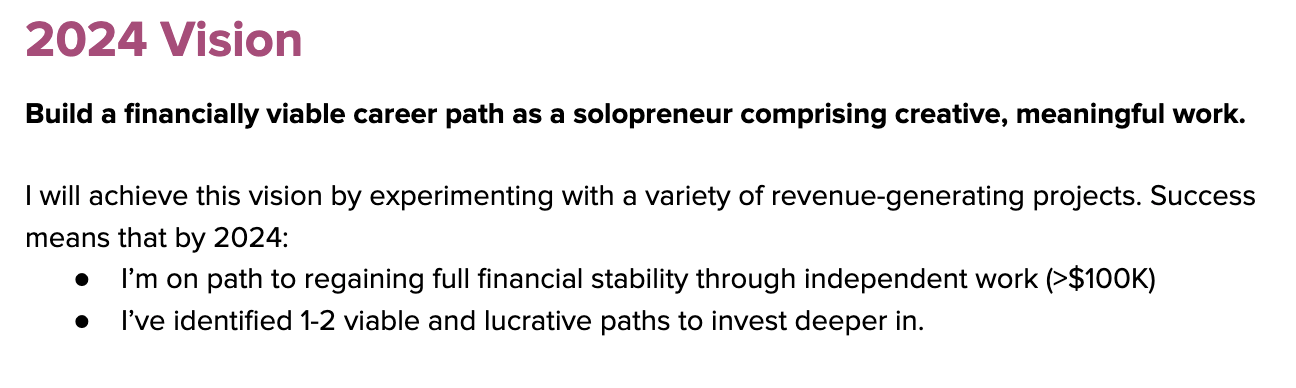
While the vision was important, it was also important that I stayed adaptable, in a structured way. The vision I created when I started served me greatly and it’s something I recommend everyone do.
Build your business with sustainability in mind
I changed a lot about my business over the past two years. Here are some nuggets of knowledge I wish someone had shared with me from the start:
Don’t charge by session. Use a subscription model and offer a package that gets clients out of a per session fee and into an outcome based mindset.
If possible, meet your clients in person. Meet at coffee shops, hotel lobbies or a park bench. The in-person connection will amplify the work 10x.
Don’t tell your clients what they need. Listen intently to the language they use and then use their language when you speak to them.
Hold up a mirror as a default response, ask for permission to give advice.
Push clients to get budget from their company for coaching. While self-paying clients often have more accountability, the self-pay model is difficult to scale.
If you don't like talking to or meeting new people, this is going to be a very hard job for you.
Sales - getting clients, speaking about your prices and helping people work through their money vulnerabilities - is a key part of the job. If you're feeling uncomfortable with any of this, work to improve this (perhaps with some support).
If you’re considering hiring a product coach, or any coach for that matter
How to hire a coach
Hiring a coach is a personal process, but here are some of the things I've seen work:
Get clear on your coaching budget. Many people I spoke to said I was out of their price range. If I knew what their budget was, I likely would have customized a plan that fit their budget constraints, especially early in my practice.
Ask about sliding scales, but don’t haggle on price, especially <$100.
If you’re struggling with the financial burdens of coaching, chat with friends who have tried coaching to get another POV and learn about how it helped them.
Ask your company to sponsor you. Many coaches will help you ask for that support including language, framing and outcomes.
Speak to a few coaches before you hire one. Coaching is relationship: it’s about credentials and chemistry. You should be willing and able to be vulnerable.
Ask a coach to speak to some of their other clients before you hire them. If coaches don’t have reference clients, they might be new OR they might not have good outcomes. You’re entitled to know, either way.
If you’re hiring a coach to help with interview support, try interviewing on your own for a month first so that you have more concrete data to work with.
Coaching is most expansive when you’re not in crisis mode. Try working with a coach from a proactive place rather than an unraveling, reactive place.
How to show up with a coach
Hiring a coach is just step one. The harder step is showing up in the right way.
If you’re not willing or unable to do the work between sessions, consider holding off on coaching. From my experience, you just won’t get much out of it.
Bring your whole self to sessions. By that, I mean professional and personal. While coaching is not therapy, life context matters. Vulnerability and transparency breed the best results.
You can level up without a coach, but you will get there faster with a coach.
A coach isn’t a silver bullet, but it’s an investment in your own development. Courses, certifications and group work are helpful, but 1:1 coaching work is powerful in ways that other modalities aren’t.
If you’re considering walking away from a traditional career path
Good on you for recognizing that you might need something different for this season of your career journey. While exploring non traditional paths has become more normalized, especially post pandemic, it’s still an incredibly scary step to take, no matter what you plan to do: coaching, consulting, fractional, freelance, founding, etc.
Wherever your journey takes you, here’s my seasoned words of wisdom:
Know what you’re signing up for
Know that betting on yourself is one of the most challenging yet rewarding experiences you can ever go through. Yes, there are tactical ways you can prepare, like budgeting how and when to take the leap, but nothing can prepare you from walking away from a steady paycheck. It takes an unbelievable amount of belief in yourself. In fact, self belief is the most important attribute you must possess. If you don’t believe in yourself, no one else will. Arm yourself with a team of people who believe in you too, especially for the days, weeks, months where your self belief wavers.
Inspired reading: 100 Year Life, 4000 Hours, The Artist’s Way
Be ready to do some identity work
When you depart a full time company role, you don’t just lose your guaranteed salary. You also lose the identity that comes with it: your company name, title, industry, etc. Don’t be surprised when the feelings around this loss come up, because they will.
Know that your identity doesn’t rely on any external defining factor.
How do we escape these traps?
The answer is simple, but not easy: We have to distance ourselves from the idea that our worth is intrinsically tied to our professional titles.
Such a shift in perspective encourages a more holistic view of success—one that values personal growth, happiness, and the pursuit of roles that truly resonate with our individual talents and passions.
Lean into experimentation
Give yourself the time and space to experiment. The people who find success on this path are adaptable, nimble and open to pivoting.
Aside from experimentation, ensure that you’re set up for success with the right resourcing: therapy, support groups, healthy habits. Do your best to create the optimal life circumstances because working for yourself is not for the faint of heart.
Maintain trust
There are few one-way doors in life.
Working for yourself isn’t one of them.
Trust that stepping away from a full time corporate role is tenable if you trust in yourself - to sustain and also to know when it’s time to eventually go back to a full time corporate role. And that any path you choose doesn’t equal failure.
Stay in service
When things get tough, because they 100% will, stay in service. Spending time with people, asking how you can help them and paying it forward will yield positive results. That’s just how the universe works.
It’s especially important when things feel like they’re falling apart.
I could go on and on and maybe I will by adding to this post over time. For now (May 2025), I’ll put a pin in it. 📌
If you’re a coach, soloprenuer, risk taker, what pieces of advice would you give someone just getting started? I’d love to hear what you’d add to this long laundry list

While soloprenuer life implicitly means solo work, this journey hasn’t been one I’ve endured alone. I have so much gratitude for the people who have believed in me, held my emotions as their own and reminded me that I am more than a business, but a human being with a lot more to offer.
To the team at Cornell Tech, especially Tyler who promptly responded to my cold LI message. You were the breath of fresh air, humor and light I needed. Shouts to the team at Intentional Product for welcoming me and continuing to be a resource.
Big thank you to Ha Nguyen, the super connecter who brought me to Prerna Singh, my product partner in crime: you’ve become more than a collaborator. You’re a true confidant and friend.
To the team at Fabrik for reminding me I have a place to call home. To mallory contois for reminding me of the joys of online and IRL community. To Tara and Mackenzie and the women in Entrepreneurship Hour who gave their time and knowledge.
To Connie and Kelly Liu for building Coaching Corner with me from another coast and creating the happiest place on the internet. To Sarah, my work wife, Adrienne and the Mastermind group, for going all the feels with me. To Brad Farris who demonstrates the highest level of being in service.
To Product Coaches like Marty Cagan for his generosity and time, Gabrielle Bufrem for her expertise and friendship and Holly Hester-Reilly for sharing nourishing lunches with me in Midtown.
To my incredible clients who took a chance on me. Your transformations changed me just as much as they changed you. 💫
To the ex-coworker group chats for reminding me why I got into this work in the first place. To my dearest of friends, old and new, that reminded me to have radical faith in myself and my track record, even when I didn’t have the time and energy to have it myself.
To Y who held every doubt of mine without any judgement. To my family - especially my parents - for never questioning me when I told them I was quitting my full time, well paying job. And to my Todd: my lawyer, silent business partner, cheerleader and steadiest rock. I couldn’t have gone on this journey without you. Thank you for everything always.
Excited about what’s ahead for you!
Congratulations, very inspiring 🪄✨