

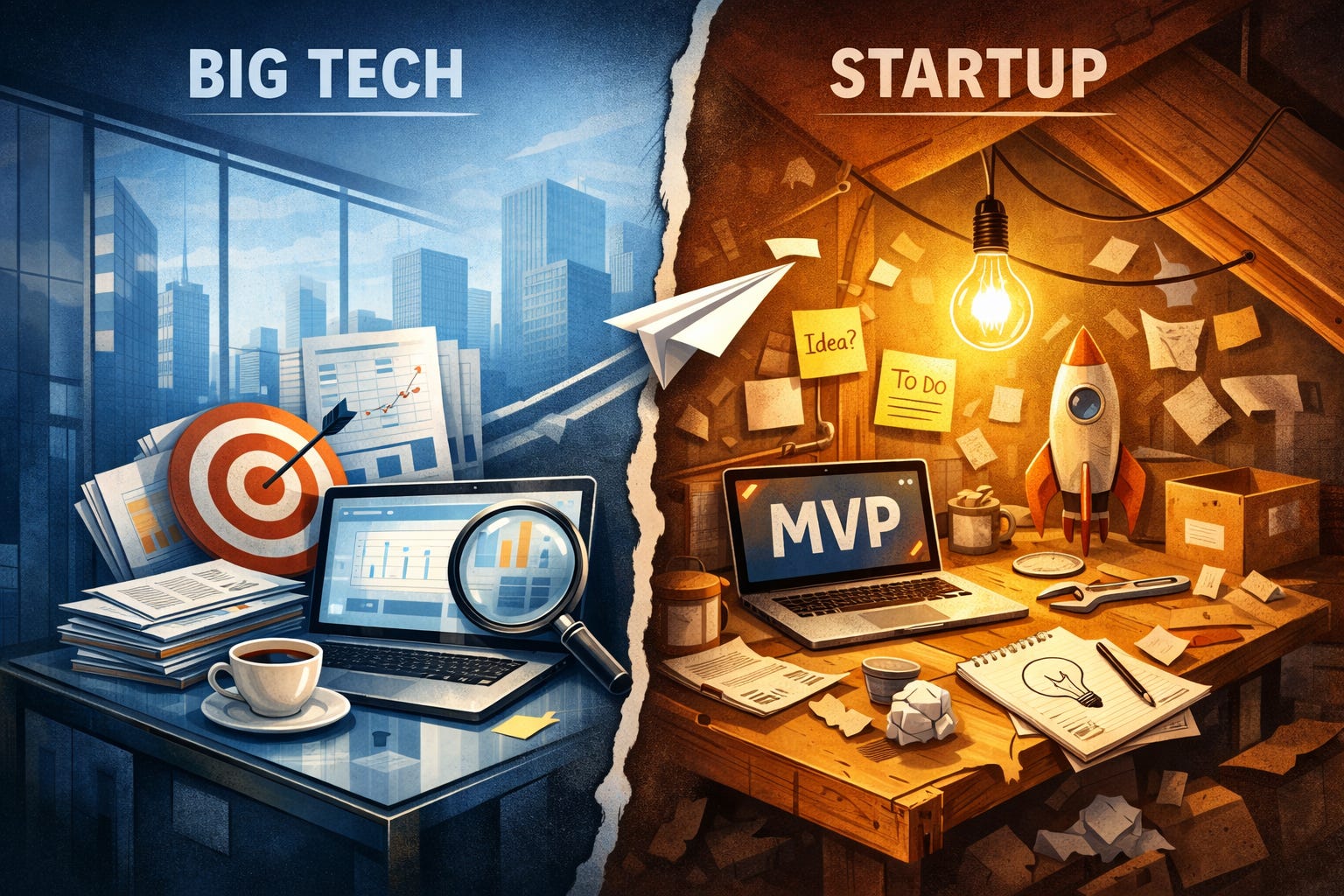
Six months ago, I reflected on my early experiences at a startup. This piece is an abstraction of that piece. Broader than the story of one company, there are bigger cultural changes that fundamentally alter how product work gets done when you move from big tech to a startup.
In fact, there are endless differences between the two. Beyond the clichés about speed or scrappiness, there are deeper shifts that are hard to prepare for. It’s one of those things you have to experience first hand.
So here goes: these are five of my lived cultural differences.
This one goes out to to the big tech PMs who are startup curious. And for the product people that made the shift well before me…what’d I miss?
1. Imperfect customer data forces you to lead with intuition
I highlighted this in my piece from a few months ago, but to no one’s surprise, startups live on imperfect data. Which means product people end up leading much more with intuition, or product sense, than they might be used to.
Pause for the weirdly ambiguous term product sense that gets slapped onto product interviews. To me, product sense = having strong instincts about what matters, paired with a relentless orientation toward solving real problems.
I’ve only worked at one place with the kind of data companies dream about1. The reality is most companies, including big tech companies (which people are shocked to hear!), have far more imperfect data than people assume.
What happens is that a lot of people wait on perfect data. And, it becomes a reason not to move. That waiting is expensive and time consuming.
Right now, I’m working in one of the most subjective data environments imaginable: I’m designing a product centered on a subjective human experience. I own a product that can produce polar opposite reactions depending on who you are. You could argue that’s an ICP problem. And you could argue that humans are an unpredictable, unique species.
Regardless of the product, startups just have less data. Especially quantitative data.
So, I’ve leaned far more heavily into qualitative data than I ever did in big tech. I use basic pattern recognition and simple customer interviews to listen for problems rather than solutions. I’m constantly checking myself that I’m not validating my solutions, but rather, listening intently for what I’m not seeing.
Hiding behind perfect data isn’t an option. When you’re at a startup, you have to move forward with what you have. It’s sharpened my instincts. And it’s helped me move quicker, leaner and more confidently than when I had a lot more quantitative data. And honestly, I don’t miss perfect data anymore.
2. Releases get radically smaller
I’ve always championed building incrementally. As you can imagine, startups take that idea and turn the volume all the way up.
When I first started, I’d present a timeline and my founder Joe would say, “Great. Let’s cut that in half.”
It was jarring. And…I realized there was an opportunity to be descoping more relentlessly. (Always Be Descoping…)
I’ve been lucky to work on teams where we did this kind of precise trimming before, slicing user stories by end-user value. But we made that happen with mature agile practices and a lot of agile coaching.
At a startup, you have to challenge yourself and your team to peel back layer after layer and ask a harder question: what is the slimmest possible v1 that still delivers value? At a startup, there’s a greater expectation that your project has been descoped rigorously.
Being at a startup has been a forcing function for stronger grooming and better sequencing. It also means we don’t get to build most of what we want to build.
That’s not a failure. That’s quite literally the point.
This Johnny Ives quote, one I’ve shared before, plays in my head weekly if not daily. And it’s become a bit of my mantra being at a startup.
Focus isn’t just saying no. It’s passing up on great ideas you’re eager to pursue in favor of the ones that align with your strategy.
3. You build the plane while flying it
Truthfully, this has been one of my hardest shifts.
At big companies, product rollouts are carefully orchestrated. I used to sit on status updates with 10+ attendees walking through massive GTM checklists. Those meetings were comprehensive but heavy.
At a startup, you are building and flying the plane at the same time. Which is, in reality, a massive change management challenge. There aren’t quarters to wait. You’ve got to move, now. I’ve compared it to an overactive operating system that needs constant updates.
Yes we use pilots and experiments but more often we are making changes to a product on a Friday that get rolled out to our customers the following Monday. The speed can be disorienting, chaotic and stressful, to say the least.
When the lifecycles are so short, the most important thing to do is to preserve optionality. I wrote about the concept of two-way doors, ironically, the month I started at Hampton.
When you’re moving fast, two-way doors must be maintained because you have to assume that what you build today may change tomorrow. It’s when trust and intuition reigns supreme. From your customers. From your team. From yourself.
4. Build what you need, because no one else will
Most blatantly, the luxuries of big tech simply don’t exist at startups. At a startup, you need agency. You need to be the kind of person who sees a gap and feels excited, not resentful, about building what’s missing.
You have to stop talking about doing the thing and actually do the thing.
You don’t have a leveling guide? Make it. You need more support? Create a hiring proposal. You need a policy for a situation that’s never arose before? Time to get drafting.
Living in big tech world felt like riding with the training wheels on. There were processes, teams, people and precedent to help you navigate the trickiest of professional or personal situations. It was equally comforting and limiting.
Flipping that notion on its head, the ways to succeed at a startup aren’t to assume precedent but rather that you’re excited and eager to break ground on something new for the company. It’s a constant game of “what got us here, won’t get us there” mentality. It requires a certain kind of energy and enthusiasm for developing v1 - from products, to people to process.
If that challenge doesn’t excite you, you’ll 100% have an uphill battle transitioning from big tech to a startup.
I often describe my experience at Audible as feeling like a cruise ship. Turning the wheel - creating real change - was an endeavor beyond my solo control. To pile onto that metaphor, Hampton is a speedboat - maybe even a jetski2. Dodging waves, finding smooth water and lots of influence to shift the direction.
5. Steadiness becomes a way of being, not an environment
If you’re looking for steady and predictable, startups are not the place. That’s traditionally what big companies promised, though even that promise has eroded in recent years with the advent of AI and tech layoffs that have plagued workers over the past few years.
My word of the year is steady.
For me, steady doesn’t mean smooth waters. Nor does it mean numbing myself to chaos. It means expecting change and using it creatively. It means improvising. Recognizing that something I build on Monday may look completely different by Wednesday, and finding energy in that shift rather than fighting it. I’ve called this, the mess you can’t live without.
This way of operating is antithetical to who I thought I was as a builder. To how I thought I liked to work. And how I thought I moved through the world entirely.
To drive the jet ski analogy home, you’ve got to be ready and excited to surf those waves. If that’s something that sounds scary or draining, a startup likely won’t be a fit for you. If you’re excited, energized and even eager to surf, a startup might be the perfect place to grow your product practice. And…
What I’m also realizing is that none of these shifts are really about big tech vs. startups…They’re really about how you react to any kind of shift - in speed, resources, vision, etc. - and how you can adjust your product practice to new environments.
When there’s no perfect data to hide behind, you have to trust your intuition.
When scope can’t sprawl, you have to focus.
When the plane is already in the air, you have to learn while flying3.
When no one hands you the process, you have to build it.
When change is constant, you’ve got to learn to ride the wave.
Startups don’t just change how you build products. They test your tolerance for ambiguity, your relationship to control and your willingness to act with agency.
I didn’t fully understand these differences until I lived them.
Hey startup PMs, what’d I miss?
Drafted while listening to West End Girl: a portrait of a woman navigating ambiguity.4
I’m Jori Bell, VP of Core at Hampton. I’m also a Product Coach for Product Leaders. I have one more open coaching spot this season-if that sounds like something you’ve been craving, reach out.
I’ll let you guess which one…
Wow, lots of vehicular metaphors today.
To put it delicately.
Great post Jori. I noticed over my career that startup vs big tech were not the only way this tomato gets sliced: hosted vs on-premise changed the equation (on-prem customers could not accept frequent new releases, and even will push back on cloud upgrades for enterprise software), consumer vs enterprise (I spent my entire career in enterprise), and new product vs mature (or, put differently, stage of adoption cycle). Eventually, all tech companies, I believe, are fated to look like big tech, because customers become more conservative with what they are looking for from you.