


I’m deep in new manager season with many of my clients right now, so setting healthy norms for IC-manager 1:1s has been very top of mind.
When I say IC-manager 1:1s, I’m talking about dedicated meeting time between a manager and their direct report to discuss work, on a regular basis.
There are plenty of templates out there to help you structure your 1:1s, so I won’t reinvent the wheel.
Instead, I want to highlight some foundational principles that I see managers and ICs consistently missing the mark on.
The strategies below are the ones I’m repeating consistently—so they’re worth channeling here too. And, while I work with product folks, these 1:1 tips aren’t just for product people.
These are just good 1:1 habits for anyone looking for more impactful 1:1 time.
I wish someone had laid this out for me earlier in my career. I spent too much time rambling through status updates. But hey, we live and we learn.
Here are my top do’s and don’t for your 1:1s.
✅ Do …
Agree on norms
A 1:1 isn’t just “a meeting.” It’s a container. Decide upfront how you want to use it.
Too many ICs defer to their manager’s way of working … and too many managers are too swamped to think about the meeting structure at all. If you don’t agree on norms, it’ll default to whatever habits each person brings—often wasting both of your time.
Some things to consider whether you’re the IC or the manager…
Decide who drives these meetings
Make it clear who’s responsible for driving the agenda. I prefer ICs drive this meeting, giving them the chance to prioritize their work, demonstrate leadership and practice managing up. It’s a meeting but it’s also an opportunity.
Clarify expectations before you meet
1:1s work best when both people know what to expect. Are you troubleshooting roadblocks? Talking through strategy? Make it explicit. See #2 and #3 below for how I think the time should be spent.
Try an Operating Manual
If you’re new to one another, setting clear 1:1 norms early can make a huge difference. It’s why I’m a huge fan of the Operating Manual.
Prep the agenda
The moment my clients start preparing for their 1:1s is the moment they really start driving their own development.
Be intentional with the agenda
A thoughtful agenda helps you focus on discussion, not information transfer. We’ve all been guilty of bumbling into a meeting without a thought. PMs spent >50% of their day in meetings. Make this meeting more useful.
Consider using time boxing tools
In the spirit of focus, consider ways to time box topics so you cover the most effective ground, not just a lot of ground. Consider this and some other practical meeting tools beyond time boxing here.
Prioritize the dreaded thing
Prioritization isn’t just an effective way of meeting. It’s a tool to demonstrate your strategic thinking. One of my favorite mantras:
Start with the dreaded thing
It’s tempting to start with the easy things, like status updates. But it’ll leave you with little time to discuss the real problems of your week. It’s the classic metaphor… a patient brings up the big topic to a therapist right as their session is ending…. Start with the most important topics and use follow up or async sessions to deal with more trivial matters. (I wrote about prioritization here and it’s worth revisiting.)
❌ Don’t …
Use your regular 1:1 time for career development discussion
Keep your career development conversations separate. If you try to shoehorn your meaty career growth conversations into your operational 1:1s, you’ll never be able to cover both.
Block separate time for development conversations
If you’re an IC, initiate a career development talk, but keep it out of your precious weekly 1:1. If you’re a manager, don’t mush the two together. You’re doing your direct report a disservice.
I’m publishing a longer piece on this later this month—subscribe to Untrapping Product Teams to hear more on the topic.
Turn it into a status update
If you’re spending your 1:1s reviewing Jira tickets or reading through status updates together, you’re doing it wrong.
Consider a pre-read with status updates
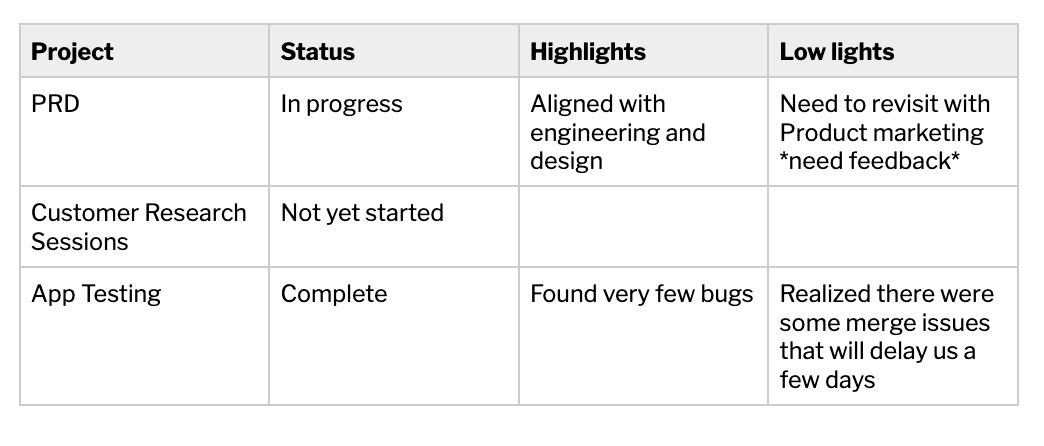
A pre - read that includes status updates gives both the IC and the manager the chance to provide necessary updates without bogging down the conversation with things that just aren’t a priority. Async visibility on topics that don’t need further discussion is just more efficient.
3) Meet just to meet
Sometimes, you don’t need a meeting. If there’s nothing pressing, an async update might be enough. Normalize canceling when appropriate.
People love the gift of “time back”1 so when you can do it, don’t be shy.
Resist the urge to fall into unconsciousness with your 1:1s.
With more intention you’ll see your meetings become richer and more impactful.
Because hey, you deserve at least one of those in your week. 😜
Hi - I’m Jori and I’m a Product Coach.
If you’re looking for support - drop me a note, I’d love to connect. 🤝
I’m also hosting a Product Power Hour, Wednesday, Feb 19th 12pm EST. It’s an open space for PMs to experience product coaching with other, supportive product folks. RSVP!
I co-host Product Leadership Breakfast NYC, a monthly product breakfast series for PM leaders. If you live in NYC or find yourself passing through, join us! ☕
And aren’t they just so annoying when they say it. It’s a top hated work-ism of mine.
Echoing one change that worked wonders for me: blocking separate “career development” sessions. Combining operational and development discussions often dilutes both. In one company I ran, I implemented quarterly career-focused 1:1s alongside weekly operational meetings. It deepened trust and helped ICs feel seen for more than their daily tasks.
Very helpful for 1 on 1s. Looking forward to seeing you on Untrapping Product Teams!